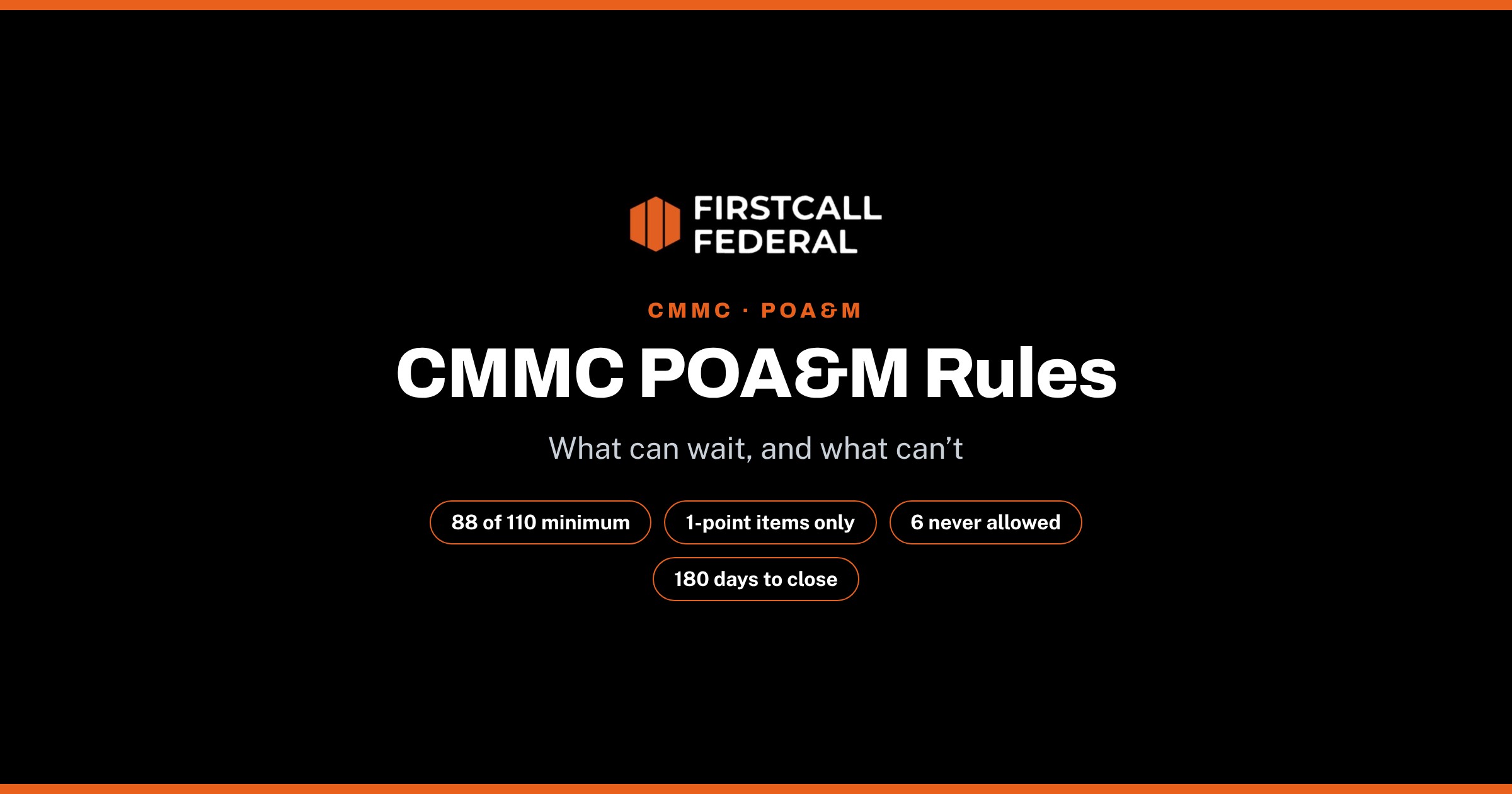
A POA&M (plan of action and milestones) lets you list security gaps you haven't closed yet and show how you'll close them. Under the CMMC rule, it only helps at Level 2, only if you score at least 88 of 110, and only for low-weight gaps. Everything on it must be closed within 180 days.
That's the short version. Here is how the rules work, and how to write a POA&M that holds up when someone checks it.
Where does CMMC stand right now?
On July 13, 2026, the Department of War suspended the move to CMMC Phase II. Phase II was set to start November 10, 2026. Phase I self-assessment requirements stay in place, and contractors must still protect covered defense information under DFARS 252.204-7012.
A September 3, 2026 class deviation told contracting officers to remove third-party assessment requirements from contracts. Self-attestation against NIST SP 800-171 is still required. As of this post, no restart date has been announced.
So why care about POA&M rules now? Two reasons. They govern Conditional status on a Level 2 self-assessment today. And they will govern C3PAO assessments when Phase II comes back.
What is a POA&M, and how is it different from your SSP?
Your system security plan (SSP) describes how each requirement is met today. Your POA&M lists the requirements that are not met yet, and the plan to meet them.
They have to agree. If your SSP says multifactor authentication is in place and your POA&M lists it as open, an assessor will notice. So will anyone reviewing your SPRS score.
When is a POA&M allowed under CMMC?
The rules are in 32 CFR 170.21. In plain terms:
- Level 1: no POA&M. All 15 requirements must be met.
- Level 2: your score divided by 110 must be at least 0.8. That means a score of 88 or higher.
- Point values: nothing worth more than 1 point can sit on the POA&M. One exception: SC.L2-3.13.11 (CUI encryption) can, if you encrypt but the module isn't FIPS-validated.
- Never on a POA&M: AC.L2-3.1.20 (external connections), AC.L2-3.1.22 (public information), CA.L2-3.12.4 (system security plan), PE.L2-3.10.3 (escort visitors), PE.L2-3.10.4 (physical access logs) and PE.L2-3.10.5 (manage physical access).
- The clock: a closeout assessment must confirm every item is closed within 180 days of your Conditional status date. If not, Conditional status expires. For a Level 2 self-assessment, you do the closeout the same way you did the original self-assessment.
Note the SSP rule. If you don't have an SSP, you can't put it on a POA&M. You have to write it first.
What should each POA&M line say?
A useful POA&M is a work plan, not a wish list. Each open item should answer these questions:
- Requirement: the exact requirement ID and its point value.
- Gap: what is missing today, in one or two plain sentences.
- Fix: the specific change (a tool, a setting, a policy, a process).
- Owner: one named person, not a department.
- Milestones: two or three dated steps, not one far-off date.
- Resources: budget, vendor or MSP work needed.
- Evidence: what will prove it's done (a screenshot, a log, a signed procedure).
- Interim protection: what reduces the risk until it's closed.
If a line has no owner or no evidence planned, it usually doesn't get closed in 180 days.
What should we do this quarter?
- Score honestly. Use the DoD Assessment Methodology and score every requirement. A high score you can't back up is a bigger problem than a lower one you can.
- Sort your gaps. Split them into "5- and 3-point items" and "1-point items." The heavy items have to be closed before you affirm with a POA&M.
- Check the never-list. Confirm your SSP and the five other excluded requirements are fully met.
- Write the POA&M lines. Use the checklist above. Put the hardest items first.
- Match the SSP. Read both documents side by side and fix anything that disagrees.
- Book the closeout. Put the 180-day date on the calendar the day you start, and work back from it.
Working with an MSP? They usually make the technical changes. Someone still has to own the plan, the evidence and the SSP. Decide who before you start.
Common questions
Can we put a missing SSP on our POA&M? No. CA.L2-3.12.4 (system security plan) is on the list of requirements that can never be on a CMMC POA&M.
What happens if we miss the 180-day deadline? Your Conditional status expires. Under the rule, that status depends on a closeout assessment confirming every POA&M item is closed within 180 days.
Does Level 1 allow a POA&M? No. Level 1 requires all 15 requirements to be met at the time of the self-assessment.
Who signs off once the POA&M is closed? A senior official at your company, the Affirming Official, submits an affirmation in SPRS after a POA&M closeout, and again annually.
Does FirstCall assess or certify our POA&M? Not if we helped you build it. FirstCall Federal is an authorized C3PAO, but CMMC rules bar anyone who helped prepare you from taking part in your Level 2 certification assessment for 3 years. If we help you build and close your POA&M, an independent C3PAO assesses you. Our team is led by a Lead Certified CMMC Assessor who has worked on more than 30 C3PAO assessments, so we prepare you for what assessors look for.
Related reading
Not sure what belongs on your POA&M?
Bring your SPRS score and gap list. We'll review them with you and scope what's left. Book a CMMC discussion with Travis.
Sources: Department of War, "Department of War Suspends CMMC Phase II Requirements" (July 13, 2026), business.defense.gov; 32 CFR 170.21 and 170.22; Nextgov, "CMMC's Phase 2 suspension locked in with binding regulation" (Sept 9, 2026). Reviewed: November 16, 2026.