

CMMC
Compliance Strategy

The Cybersecurity Maturity Model Certification (CMMC) is a framework that was created by the US Department of Defense (DoD). The DoD aims to enhance the cyber security of the Defense Industrial Base (DIB) and protect sensitive government information. This sensitive government information includes Federal Contract Information (FCI) and Controlled Unclassified Information (CUI).
The framework was made to make the DIB sector (which helps the DoD) more secure. The DIB sector includes more than 300,000 companies and organizations. In this article, we will cover the basics of CMMC compliance and what you need to know to prepare for it.
What is CMMC?
The CMMC is a cyber security rule for contractors and subcontractors of the DoD who handle FCI or CUI. They must satisfy certain security requirements based on the level of security needed for the information they deal with. There have been two versions of CMMC, version 1.0 and 2.0. The DoD created version 2.0 in response to numerous requests from the DIB to simplify the requirements.
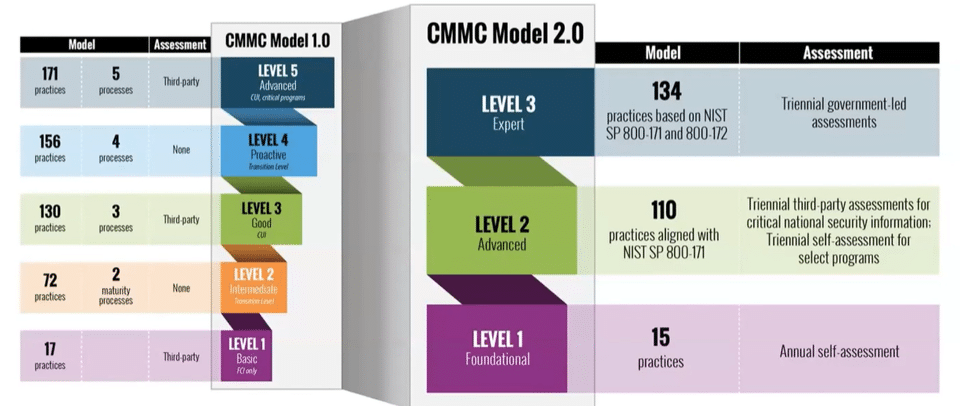
Version 1.0 had five levels of maturity. Each level had a different number of cyber security practices and procedures that had to be implemented. In version 1.0, every level had to be verified by a CMMC Third-Party Assessment Organization (C3PAO). In version 2.0, Level 1 is an annual self-assessment, most Level 2 organizations need a C3PAO assessment, and Level 3 is assessed by the government (DCMA DIBCAC). C3PAO’s are authorized by the Cyber AB (formerly the CMMC AB) to conduct these assessments.
CMMC 2.0 was created to simplify the requirements. They removed levels 2 and 4 from the previous 1.0 version so now there are only 3 levels. Additionally, some other changes are:
- The removal of processes entirely
- The requirements for Level 2 (formerly level 3) have been decreased to align with the NIST 800-171 standard
- Brought back Plan of Action and Milestones (POAM) for a limited number of controls
Why is CMMC important?
The DIB sector is a critical part of the US economy, providing goods and services to the DoD. Attacks on the DIB sector can have severe consequences, such as stealing government information, disrupting essential infrastructure, and compromising national security. The certification was designed to help protect contractors from cyber threats by ensuring a minimum level of cyber security maturity.
What are the CMMC Levels?
The first version of the framework had five levels of maturity, starting from basic cyber security practices to advanced processes. Each level builds upon the previous level and adds additional cyber security practices and processes. The five levels of Version 1.0 were:
Level 1: This level required contractors to implement basic cyber security practices. These included anti-virus software, passwords, and limiting who can access company systems.
Level 2: This level required contractors to implement additional cyber security practices such as access control, incident response, and configuration management.
Level 3: This level required contractors to implement a comprehensive set of cyber security practices and processes. This included periodic reviews of security controls and policies.
Level 4: This level required contractors to implement advanced cyber security practices and processes, including continuous monitoring and threat hunting.
Level 5: This level required contractors to implement the most advanced cyber security practices and processes. This included real-time response to cyber threats and the use of cutting-edge technologies.
Version 2.0 now only has 3 levels. Most organizations that handle CUI are going to require level 2 certification, and undergo a third-party assessment every three years.
How can organizations prepare for CMMC compliance?
Organizations can prepare for CMMC compliance by beginning to implement the practices that are required. Companies should conduct a gap analysis to compare their current cyber security status to the CMMC requirements. This will reveal areas that need improvement, and this is the foundation of your POAM.
To get Level 2 certification, most organizations will need to undergo a CMMC assessment by a C3PAO. The assessment will check if the company’s cyber security practices meet the required level of CMMC certification they’re seeking.
When will CMMC be implemented?
The CMMC program rule (32 CFR Part 170) took effect on December 16, 2024, and the DFARS rule that puts CMMC requirements into DoD contracts took effect on November 10, 2025. The DoD is phasing CMMC into contracts over several years.
Conclusion
The CMMC framework is an important step forward in improving the cyber security posture of the DIB sector. It was created because the DoD is interested in protecting FCI and CUI. It provides a standardized approach to cyber security that ensures all contractors meet a minimum level of cyber security maturity.
Companies that want to bid on DoD contracts must start working on CMMC compliance now. CMMC is being phased into DoD contracts that involve FCI or CUI. Companies that don't meet the required level will not be eligible for those contracts as either a prime or sub-contractor.
Getting CMMC compliant can take months, depending on the level of maturity required for the contracts. Companies that are not compliant should start preparing now to allow enough time to implement the required practices and get assessed.
In addition to the requirement for DoD contracts, pursuing CMMC compliance can also benefit organizations in several ways. Following the CMMC framework can make companies more secure, reduce the risk of cyber threats, and protect their sensitive information. This can help build trust with customers and partners, and enhance their reputation.
Furthermore, the CMMC framework is not just for organizations in the DIB sector. Other government agencies, as well as private organizations, are beginning to adopt the framework as a standard for cyber security. By becoming CMMC compliant, organizations can position themselves as leaders in cyber security and gain a competitive advantage in the marketplace.
To win contracts from the DoD in the future, companies should start preparing to meet the CMMC requirements now. If your organization is planning to bid on DoD contracts, then it’s crucial to ensure that you’re CMMC compliant. It’s essential to conduct a CMMC gap assessment to avoid any risk of losing future contracts.
Our experts can assess your current cyber security status and identify areas that need improvement to meet the CMMC requirements. A gap assessment will help you understand your current cyber security status and create a plan to become CMMC compliant. Contact us today to conduct a CMMC gap assessment and get on track towards compliance.